Why So Many Women Feel Dismissed in Healthcare - And What Personalized Medicine Changes

There is a particular kind of exhaustion that comes not from being sick, but from not being believed about it. For too many women, that exhaustion is familiar. Here is what the data says about why it happens — and what a different model of care actually changes.
Last updated May 2026
There is a particular kind of exhaustion that comes not from being sick, but from not being believed about it. Women across every age group, every background, and every health status describe a version of the same experience: they bring a concern to a doctor, and somewhere between the waiting room and the exam room, the concern gets smaller. Minimized. Attributed to stress, hormones, or anxiety. Something to monitor rather than address.
This is not an isolated experience. According to a 2022 KFF Women's Health Survey, nearly 29 percent of women reported that their doctor had dismissed their concerns during a healthcare visit in the prior two years, compared to 21 percent of men. Fifteen percent of women said a provider had not believed they were telling the truth. These are not outliers. They represent a systemic pattern in how women move through the healthcare system, and the consequences extend well beyond a frustrating appointment.
A 2019 study published in Nature Communications, drawing on health data from 6.9 million Danish patients, found that women are diagnosed an average of four years later than men across more than 700 diseases. For cancer, that gap is 2.5 years. For metabolic conditions like diabetes, it exceeds 4.5 years. The gap is not simply biological. It reflects, in part, a healthcare system built around male physiology and slow to course-correct.
Understanding why this happens is the first step. Understanding what a different model of care looks like is where things begin to change.
Why the Standard System Falls Short for Women
The structure of traditional primary care creates conditions where dismissal is almost inevitable. Appointment slots average 15 to 20 minutes. Within that window, a physician must review the chart, address the chief complaint, manage any chronic conditions, order labs, document everything, and move on to the next patient. There is rarely time for the kind of conversation that catches what the chart doesn't show.
Women often present with symptoms that require that kind of conversation. Fatigue, sleep disruption, changes in mood, joint pain, irregular cycles, reduced libido, brain fog, and a general sense that something is off are real clinical signals. They are also difficult to communicate with and easy to dismiss in a rushed setting. When a provider is pressed for time, the path of least resistance is reassurance and a return visit that may be months away.
This dynamic is compounded by a longstanding gap in medical research. For decades, clinical studies disproportionately enrolled male subjects, and the findings were generalized to women without accounting for meaningful physiological differences. Women present differently with heart disease. They experience autoimmune conditions at higher rates. Hormonal transitions across the reproductive lifespan create clinical complexity that many providers were not trained to navigate with confidence.
The result is a healthcare relationship where women often leave appointments without answers, without a plan, and without confidence that they were taken seriously.
What Changes in a Relationship-Based Model
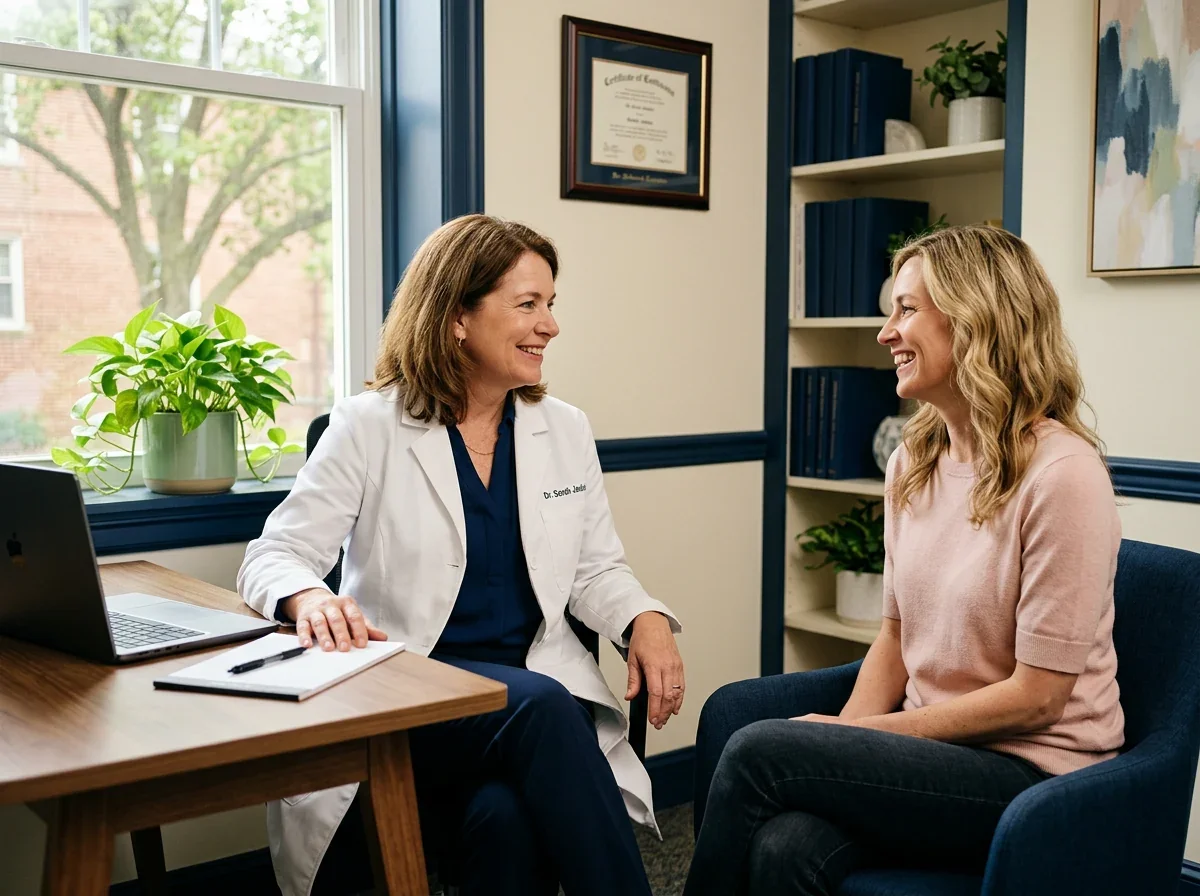
Concierge primary care is structured differently from the ground up. The patient panel is kept small by design, so when a patient calls, there is a physician who already knows her. Not just her medications. Her life. Her work stress, her sleep history, her family health context, and the way she has described symptoms in prior visits. That continuity of knowledge changes what is possible in a single appointment.
At Concierge Medicine of South Shore, Dr. Maria Clarinda Buencamino-Francisco, known to her patients as Dr. B, built her practice on exactly this model. Board-certified in internal medicine and holding both the Certified Clinical Densitometrist (CCD) credential and the Menopause Society Certified Practitioner (MSCP) designation, Dr. B brings specialized clinical depth to the kind of patient relationships that standard primary care rarely allows time for. Her focus is preventive, evidence-based, and grounded in the particular health needs of women navigating midlife and beyond on the South Shore.
Her patients describe something that sounds simple but is actually uncommon: a doctor who listens, figures things out, and follows through.
The Preventive Medicine Difference
One of the most significant shifts in concierge care is the emphasis on proactive rather than reactive medicine. In a traditional model, care tends to be organized around problems that have already emerged. A patient comes in because something is wrong. The appointment addresses that specific thing. The underlying conditions that may have contributed to it, or the risks that are quietly accumulating, rarely make it onto the agenda.
A preventive model works differently. It creates space for:
Comprehensive baseline assessments that establish where a patient is starting from, not just what is acutely wrong
Longitudinal tracking that identifies patterns across time rather than treating each visit as an isolated event
Screening discussions that are actually personalized to a patient's history, risk factors, and life stage, rather than applied from a generic checklist
Proactive conversations about hormonal transitions, bone health, cardiovascular risk, metabolic changes, and mental health before they become crises
This is particularly meaningful for women in their 40s, 50s, and 60s. Perimenopause and menopause are not single events. They are extended physiological transitions that can affect every system in the body and that many physicians are not equipped to manage comprehensively. A 2018 study from the Mayo Clinic found that fewer than seven percent of internal medicine, family medicine, and OB/GYN residents felt prepared to manage a patient going through menopause. The MSCP credential that Dr. B holds represents a direct commitment to filling that gap with current, evidence-based training.
What Women Gain When They Feel Heard
It is worth being specific about what changes when a patient has a physician who knows her, has time for her, and takes her concerns seriously. The benefits are not just emotional, though the emotional dimension is real and significant. They are clinical.
Symptoms that arrive gradually, the ones that are easy to explain away, get documented and tracked instead of forgotten
Hormonal changes are addressed rather than normalized away
Cardiovascular risk factors in women, which present and progress differently than in men, receive the kind of attention they deserve
Mental and physical health are treated as connected, not as separate silos
Patients are more likely to disclose fully when they trust that what they say will be received without judgment
The continuity that concierge care provides also reduces a specific kind of fatigue: the exhaustion of having to re-explain your history to different providers. In a relationship-centered practice, the physician already knows. You are building on a shared understanding rather than starting over.
A New Era in Women's Health
This year's National Women's Health Week theme, "Prevention, Innovation, and Impact: A New Era in Women's Health," points toward exactly what practices like Concierge Medicine of South Shore are already building. The innovation here is not primarily technological. It is relational. It is the return of something medicine has struggled to maintain at scale: a physician who knows her patient, has time to listen, and brings the clinical knowledge to act on what she hears.
Women in Hingham, Cohasset, Scituate, and across the South Shore deserve care that treats their symptoms as meaningful, their questions as worth answering, and their long-term health as something worth planning for rather than managing after the fact. That is what preventive, relationship-centered medicine makes possible. And it is exactly what Dr. B has built.
If you are ready to experience a different kind of primary care, Concierge Medicine of South Shore is accepting new members. Schedule a complimentary meet-and-greet to learn more.